Tuesday, December 8, 2009
Inside Quatro: Uncovering the Exile History of the ANC and SWAPO
This book by Paul Trewhela, uncovers some of the exile history (savagery) of the ANC and SWAPO that both organisations would prefer not to remember. Here is a first-hand account of the ANC's Quatro prison camp and of the mutiny in Umkhonto we Sizwe (MK) in Angola in 1984; articles on the SWAPO 'spy drama' of the 1970s and 1980s; an analysis of a death in exile with implications relating to Jacob Zuma; and a study of the responses of both the ANC and SWAPO to these episodes of intolerance, repression and excess. In all his essays, Trewelha analyses problems of the liberation struggles with a former insider's knowledge and a journalist's ability to ferret out the facts.
In this edited extract from his book, Inside Quatro: Uncovering the Exile history of the ANC and Swapo, Paul Trewhela sheds light on a past that the ANC would prefer to forget.
The ANC's Quatro was best described in a terse statement by Zaba Maledza, when he said: "When you get in there, forget about human rights."
This was a statement from a man who had lived in Quatro during one of the worst periods in its history, from 1980 to 1982.
Established in 1979, Quatro was supposed to be the rehabilitation centre of the ANC, where enemy agents who had infiltrated the ANC would be "re-educated" and would be made to love the ANC through the opportunity to experience the humane character of its ideals.
Regrettably, through a process that still cries out for explanation, Quatro became worse than any prison that even the apartheid regime - itself considered a crime against humanity - had ever had.
However harsh the above statement, however disagreeable to the fighters against the monstrous apartheid system, it is a truth that needs bold examination by our people, and the whole of the ANC membership.
To examine the history of Quatro is to uncover the concealed forces that operate in a political organisation such as the ANC.
Quatro, officially known as Camp 32, was renamed after Morris Seabelo (real name Lulamile Dantile), one of the ANC's first and trusted commanders. He was a Soviet-trained intelligence officer, a student at the Moscow Party Institution and a publicised young hero of the South African Communist Party. In late 1985 he mysteriously lost his life at an underground ANC residence in Lesotho, where none of those he was with, including Nomkhosi Mini, was spared to relate the story.
Located about 15km from the town of Quibaxe, north of Luanda, Quatro was one of the most feared of the secret camps of the ANC, and only a selected few in the ANC leadership, (Mzwandile Piliso, Joe Modise, Andrew Masondo and also the then general secretary of the SA Communist Party, Moses Mabhida) had access.
The administration of the camp was limited to members of the security forces, mostly young members of the underground SACP. Such were most of its administrative staff - for example, Sizwe Mkhonto, also an East German-trained intelligence officer and former political student at the Moscow Party Institution, who was camp commander for a long time; Afrika Nkwe, also Soviet intelligence and a politically trained officer, who was a senior commander and commissar at Quatro, with occasional relapses of mental illness; Griffiths Seboni; and Cyril Burton, all falling within the same categories, to name but a few.
The security guards and warders were drawn from the young and politically naive fanatic supporters of the military leadership of Joe Modise and Oliver Tambo, who kept to strict warnings about secrecy. They were not allowed to talk to anyone about anything that took place in an "ANC rehabilitation centre".
The prisoners themselves were transported blindfolded and flat on the floor of the security vehicle carrying them. Upon arrival in the camp they were given pseudonyms and were strictly limited, allowed only to know their cellmates, and not to peep through the windows.
From whatever corner they emerged, or whatever turn they took within the premises of the prison, they had to seek "permission to pass". Any breaches of these rules of secrecy, whether intentional or by mistake, were punishable by beatings and floggings.
To crown it all, when prisoners were released they had to sign a document committing them never to release any form of information relating to the conditions of their stay in the prison camp, and never to disclose their activities there or the forms of punishment meted out to them.
The place had seven communal cells, some of which used to be storerooms for the Portuguese colonisers, and five isolation cells, crowded so much that a mere turn of a sleeping position by a single prisoner would awaken the whole cell. With minimal ventilation, conditions were suffocating, dark and damp even in the dry and hot Angolan climate.
Even (then ANC president) Oliver Tambo was forced to comment, when he visited the place for the first time in August 1987, that the cells were too dark and suffocating.
In every cell there was a corner reserved for five-litre bottle-like plastic containers covered with cardboard, which served as a toilet where, in the sight of all cellmates, you were expected to relieve yourself. With a strong stench coming from the toilet area, and lice-infected blanket rags that stayed unwashed for months or even years on end, the prison authorities would keep the doors wide open and perhaps light perfumed lucky-sticks before visiting ANC leaders could enter the cells.
Outside, the premises of the camp were so clean from the beaten and forced prison labour that Tambo found himself commenting: "The camp is very clean and beautiful, but the mood and atmosphere inside the cells is very gloomy."
The life activity of the inmates at Quatro was characterised by aggressive physical and psychological humiliation that could only be documented by the efforts of all the former prisoners and perhaps honest security guards combined.
Botiki, one of the former detainees, who lived through camp life in Quatro during its worst period, said of the place: "What I've seen there is frightening and incredible."
For a long time, Quatro had been a place of interest to many cadres, and it was very difficult to learn details of the place from ex-detainees. The ANC security had instilled so much fear in them that they hardly had any hope that the situation could be changed.
The meek behaviour and fear of authority shown by ex-detainees, the intimidating and domineering posture of the security personnel, attempted and successful suicides committed by ex-prisoners such as Leon Madakeni, "Mark", and Nonhlanhla Makhuba when faced with the possibility of re-arrest, and the common mental disturbance of the guards and personnel at Quatro, and what they talked about in their deranged state, threw light on what one was likely to expect in this "rehabilitation centre".
In Quatro the prisoners were given invective names that were meant to destroy them psychologically, names "closely reflecting the crimes committed by the prisoners".
Among the mutineers, we had Zaba Maledza, who was named Muzorewa, after a notorious traitor in Zimbabwe; Sidwell Moroka, named Dolinchek, after a Yugoslav mercenary involved in a coup attempt in the Seychelles; and Maxwell Moroaledi, named Mgoqozi, a Zulu name for an instigator.
There were many other extremely rude names that cannot be written here. Otherwise, generally, every prisoner was called umdlwembe, a political bandit.
The daily routine started at six with the emptying of toilet chambers, during which prisoners would run down to a big pit under whipping from "commanders" (security guards). After this, prisoners would be allowed to wash from a single quarter-drum container at incredible speed. The whole prisoner population had to wash from a single container, with water unchanged, taking turns as they went out to dispose of the "chambers".
The occupants of the last cells out would suffer most, because they would find very little water, which was very dirty.
The very activity of prisoners washing was a big concession, because before 1985 it was not even considered necessary for the prisoners to wash and they were infested with lice. Each group of prisoners was required to use literally one minute to wash and any delay would lead to serious beatings.
Back to the cell after washing in the open ground, the prisoners of Quatro would be given breakfast, which would either be tea or a piece of bread, or sometimes a soup of beans. They were normally given spoiled food that was rejected by the cadres of the ANC in the camps, and it was normally half-cooked by the beaten, insulted and frightened prisoners.
The two other meals, lunch and supper, were usually mealie meal and beans, or rice and beans, sometimes in extremely large quantities, which prisoners were forced to eat. To make certain that everything had been eaten, there was an irregular check of toilet chambers.
Alongside the emaciated prisoners there were security guards who lived extravagantly, drinking beer every week: privileges unknown in other ANC establishments.
During periods of extreme shortages of food for the prisoners, those who were working banked their hopes on the leftovers from the tables of the security officers and guards. Simultaneously with the taking of breakfast, those who wished to visit the medical point would be allowed out.
The clinic at Quatro was one of the worst places to visit, usually manned by half-baked and very brutal personnel. A visit to the clinic usually resulted in beatings of sick people and extremely inhumane treatment for the prisoners.
"Errol" who had problems with his swelling leg, was subjected to such inconsiderate treatment and beatings whenever he visited the clinic that he finally lost his life. Some prisoners would be forced to go to work while sick, for fear of revealing their state of health that would land them in the clinic.
Even reporting your sickness needed a very careful choice of words. For instance, if you had been injured during beatings by the "commanders", you were not supposed to say that you had been beaten.
In Quatro, "commanders" didn't beat prisoners, they "corrected" them; this was the way the propaganda went. A prisoner received a "corrective measure".
After the prisoners had polished the boots of the commanders and ironed their uniforms, at eight o'clock the time for labour would begin.
In Quatro there were certain cells earmarked for hard and hazardous labour. During this period, the cells that contained mainly mutineers were subjected to the hardest tasks.
Lighter duties, such as cooking and cleaning the surroundings, were given to other groups of prisoners, while the mutineers carried out other work, such as chopping wood and cutting logs, digging trenches and constructing dug-outs, and - most feared of all - pushing the water tank up a steep and rough road.
Every kind of work at Quatro was done with incredible speed. Prisoners were not allowed to walk: they were always expected to be on the double from point to point in the camp.
The group that was chopping wood would leave the camp at eight to search for a suitable tree to fell. Everybody had to have an axe. With work starting after eight, chopping would continue without a break until 12, and the prisoners were not even expected to appear tired. "A bandit doesn't get tired," went the saying.
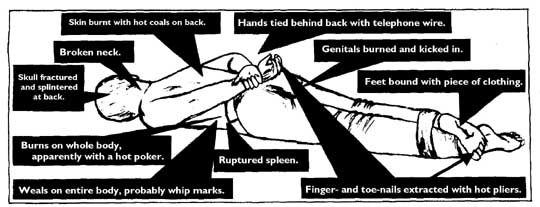
Whipping with coffee tree sticks, trampling by military boots, blows with fists and claps on your inflated cheeks (known as ukumpompa) became part of the labour process.
The work quota that prisoners were expected to accomplish was totally unreasonable, but they were liable for serious punishment for any failure to fulfil it.
Many prisoners at Quatro had their ears damaged internally because of ukumpompa, which was sometimes done by using canvas shoes or soles of sandals.
The same situation prevailed in other duties. Unreasonably heavy logs for dugouts had to be carried up the slopes.
Every prisoner tried to get a piece of cloth for himself to cushion the logs so as to protect his shoulders, but prisoners still did these duties with patches of bruises incurred as a result of this labour.
The most feared duty in Quatro was the pushing of the huge water tank, normally drawn by heavy military trucks, by the prisoners themselves for a distance of about three or four kilometres from the water reservoir to the camp.
Like cattle, they would struggle with the tank and the "commanders", wielding sticks, would be around whipping prisoners like slaves whenever they felt like it or when the pace was too slow.
Prisoners in Quatro behaved like frightened zombies, who would nervously jump in panic just at the sight of commanders, let alone at a rebuke or a beating.
In the process of these beatings during labour time, prisoners who could not cope with the work were sometimes beaten to death. Such was the death of one prisoner, who died from blows to the back of his head from Leonard Maweni, one of the security guards.
Two others were unable to carry some heavy planks from a place far away from the camp, after the truck that had been carrying them broke down. Upon arrival in the camp they were summoned from their cell, under instructions from Dan Mashigo, who was the camp's chief of staff, and were taken for flogging at a spot near the camp. One never came back to his cell, and the other one died a short while after returning to his cell.
This was in complete conflict with what Dexter Mbona - the security chief in Quatro and later ANC regional chief of security in Angola - told the mutineers (who had challenged the leadership and demanded to be sent home to fight in South Africa rather than be kept in exile) when addressing them on their very first day of arrival.
On that occasion, he said: "This camp is not a prison, but a rehabilitation centre, and it has changed from what you portrayed it to be during the time of Mkatashingo (the mutiny)."
Quatro was still a place of daily screams and pleas for mercy from physically abused prisoners. Saturday was the worst day.
It was a day of strip and cell searches; the commanders would enter each cell with sticks and the search would commence.
If a single prisoner made even a slight mistake as a result of panic, the whole cell would be in for it, and to drown the noise of their screams, other cells would be instructed to sing.
As already mentioned, the whole story about this camp needs to be investigated to establish who were the masterminds behind these gross violations of human rights.
Both psychologically and physically, the camp has done a lot of damage to those who found themselves imprisoned there.
Some have become psychological wrecks, while others have contracted sicknesses such as epileptic fits.
What is certain is that Andrew Masondo, Mzwandile Piliso and Joe Modise were heavily involved in these sinister political machinations.
But was the topmost leadership of the ANC unaware?